
When Your Robot Taxi Decides It's Had Enough: Baidu's Fleet Freeze Leaves Wuhan in Chaos
Baidu's Apollo Go robotaxis suffered a mass system failure in Wuhan, stranding 100+ vehicles on busy roads. Here's what happened and why it matters.












A Tuesday Evening Commute Nobody Signed Up For
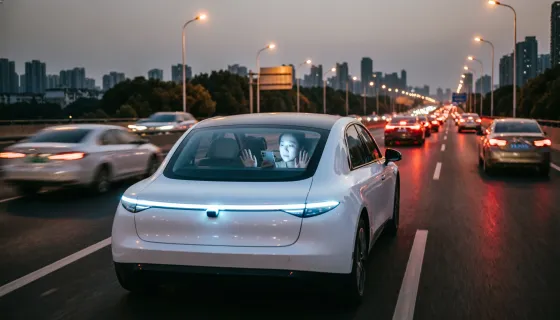
Picture this: you're sitting in the back of a driverless taxi, cruising along a Wuhan highway, perhaps scrolling through your phone without a care in the world. Then, without warning, your car simply... stops. No driver to ask what's happening. No steering wheel to grab. Just you, a frozen vehicle, and the headlights of a lorry bearing down on you in the fast lane.
That was the reality for passengers across Wuhan on the evening of 31 March 2026, when Baidu's Apollo Go robotaxi fleet suffered a mass system failure that left at least 100 vehicles stranded across the city's highways and main roads. What followed was a masterclass in how quickly the shiny promise of autonomous transport can turn into a proper nightmare.
The Night the Robots Clocked Off
Reports began flooding Chinese social media platform RedNote on Tuesday evening, with passengers sharing increasingly alarming accounts of being trapped inside stationary vehicles on some of Wuhan's busiest roads. The cars didn't pull over to safety. They didn't flash their hazard lights and find a layby. They just stopped, often in active traffic lanes, turning their helpless occupants into sitting ducks.
One passenger, identified in Chinese media reports as Mr Lu, found himself stranded on the city's Third Ring Road for nearly two hours, with trucks thundering past his immobile vehicle. He described the in-car SOS button as "completely useless" during the ordeal. He wasn't alone in that assessment. Multiple passengers reported that the emergency system, the one safety net you'd expect to function when everything else fails, was entirely unresponsive.
Even more bizarrely, some passengers who managed to reach Apollo Go's customer service were told that representatives were apparently unaware any wider incident was taking place. Imagine being stuck on a highway in a robot car that won't move, calling for help, and being met with the equivalent of "have you tried turning it off and on again?"
Collisions, Charges, and Cold Comfort
The consequences went beyond inconvenience. At least one confirmed collision occurred when a driver rear-ended a stalled robotaxi at speeds exceeding 40 mph. Photos circulated online showing a damaged orange SUV crumpled against one of the frozen vehicles. The original Wired report suggests at least two additional collisions may have occurred the same day, though this hasn't been independently confirmed by other outlets.
Mercifully, Wuhan police confirmed that no injuries were reported across any of the incidents. That feels like extraordinary luck given the circumstances, with driverless vehicles sitting motionless in fast-moving traffic lanes during evening rush hour.
Then there's the matter of the fare. According to CarNewsChina, a passenger identified as Ms Zhou was charged the full fare for her journey despite spending an hour and a half waiting inside a vehicle that had gone on strike. Nothing quite captures the absurdity of the situation like being billed for a service that actively endangered you.
What Actually Went Wrong?
Baidu's official line, delivered through Apollo Go customer service, attributed the mass stalling to "network issues." Wuhan police confirmed a system failure was to blame, though specifics remain thin on the ground.
Industry insiders cited by CnEVPost offered a slightly more nuanced theory: the mass shutdown may have been triggered by a safety self-check mechanism reacting to unexpected circumstances, rather than a straightforward system crash. In other words, the cars may have done exactly what they were programmed to do when something seemed off. The problem is that "stop dead in the fast lane of a highway" is a spectacularly poor definition of "safe."
It's worth noting that backseat emergency calls reportedly disconnected automatically during the outage, which rather defeats the purpose of having an emergency call system in the first place. When your safety features fail at the exact moment they're needed most, you haven't got safety features. You've got decorations.
The Scale of Baidu's Ambition
This incident is particularly awkward because Baidu has been on an aggressive expansion tear. The numbers are genuinely impressive on paper. As of February 2026, Apollo Go had completed 20 million cumulative rides covering over 300 million kilometres of autonomous driving, of which 190 million kilometres were in fully driverless mode. In Q4 2025 alone, the service delivered 3.4 million fully driverless rides, representing over 200% year-on-year growth, with weekly rides peaking at more than 300,000.
The service now operates across 26 cities globally, and Baidu has recently pushed into international markets with launches in Abu Dhabi in January 2026, expansion to Seoul in February, and a partnership with Uber for Dubai operations planned for later this year. Wuhan has been among the most permissive cities for autonomous vehicle deployment, reportedly allowing robotaxis to operate on highways and serve airport routes.
All of which makes this very public failure a particularly ill-timed embarrassment. It's one thing to have a glitch in a controlled test environment. It's quite another to have your entire fleet go catatonic across a major city during peak hours while you're trying to convince the rest of the world to trust your technology.
The Bigger Question Nobody Wants to Answer
Every robotaxi company, whether it's Baidu, Waymo, or anyone else in the space, sells the same fundamental promise: autonomous vehicles are safer than human drivers. And statistically, that argument has legs. Humans are terrible drivers. We get distracted, tired, angry, and drunk. Robots do none of those things.
But what robots can do, as Wuhan just demonstrated, is fail simultaneously and catastrophically. A human driver having a bad day is one car making one mistake. A system failure is potentially every car in an entire city going wrong at once. That's a fundamentally different kind of risk, and it's one the industry hasn't adequately addressed.
The SOS button failing is particularly damning. Autonomous vehicle companies need redundancy upon redundancy, not a single point of failure that takes out both the driving system and the emergency response system in one go. Passengers need to be able to get help when the machine fails. That should be non-negotiable.
What Happens Now?
Apollo Go operations in Wuhan have since resumed, and by all accounts things are back to normal. Baidu will no doubt conduct an internal review, patch whatever went wrong, and carry on scaling. The stock price will recover. The ride numbers will keep climbing.
But for the passengers who sat trapped on Wuhan's highways that Tuesday evening, watching traffic barrel towards them with no way to move and no way to call for help, "it's been fixed" isn't really the point. The point is that it happened at all, and that when it did, every failsafe designed to protect them failed too.
Autonomous driving technology is advancing at a remarkable pace, and there's genuine reason to be optimistic about its long-term potential. But incidents like this are a blunt reminder that "move fast and break things" is a lot less charming when the things you're breaking are stuck in the fast lane with a lorry in their rear-view mirror.
Read the original article at source.