
A Robot Got 'Arrested' in Macau, and Honestly, the Future Is Weirder Than We Expected
A humanoid robot was escorted away by police in Macau after startling an elderly woman. Here's what really happened and what it means for the future of robots in public spaces.












The Incident That Broke the Internet (and One Woman's Nerves)
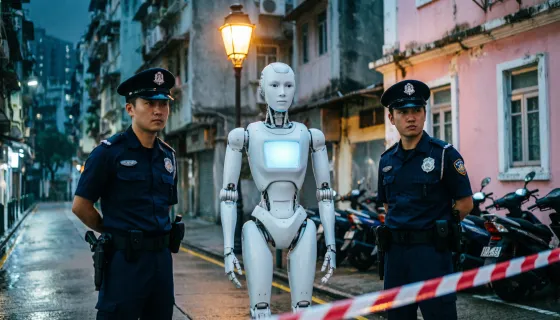
Picture this: it is a Thursday evening in Macau, roughly 9 PM on 6 March 2026. A 70-year-old woman is strolling near the Lok Yeung Fa Yuen residential complex in the Patane district, minding her own business, scrolling through her phone. Behind her, a four-foot-four bipedal humanoid robot silently appears like the world's most unsettling shadow.
The woman, understandably startled, reportedly yelled at the machine in Cantonese: "You're making my heart race!" and "You've got plenty to do, so what's the point of messing around with this? Are you freaking crazy?"
Honestly? Fair enough.
Within minutes, Macau police arrived on the scene, surrounded the robot, and escorted it away. The internet, naturally, lost its collective mind. Headlines screamed about the "world's first robot arrest." Social media had a field day. Memes were born. And somewhere, a 50-year-old robot operator quietly collected his very expensive toy from the police station while receiving a stern talking-to.
But before we get too carried away with visions of humanoid robots doing perp walks, let us untangle what actually happened here, because the reality is both less dramatic and somehow more fascinating than the tabloid version.
What Actually Happened (Spoiler: No Handcuffs Were Involved)
Despite the viral headlines, this was not a formal arrest. Not even close. Macau police escorted the Unitree G1 robot away from the scene and returned it to its operator. No charges were filed. No robot was read its rights. The operator, a 50-year-old man who worked for a local education centre, was given a caution and sent on his way.
The robot had not been "harassing" the elderly woman in any meaningful sense of the word. It startled her by appearing behind her unexpectedly. There was no physical contact. Police confirmed as much. The woman was taken to hospital as a precaution, but she was not injured and was discharged shortly afterwards. She declined to file a complaint.
So, to be clear: a remotely operated robot accidentally frightened a pensioner, police removed the robot, gave the operator a warning, and everyone went home. That is the actual story. Everything else is social media seasoning.
Meet the Unitree G1: The Robot at the Centre of It All
The machine in question is the Unitree G1, a compact bipedal humanoid robot launched in May 2024 by Chinese robotics firm Unitree Robotics. Standing at 4 feet 4 inches tall, it is roughly the height of an average 9-year-old, which somehow makes it both less intimidating and more unsettling at the same time.
At launch, the G1 carried a price tag of approximately $13,500, which Unitree marketed as making it one of the more "affordable" humanoid robots on the market. Affordable is doing quite a lot of heavy lifting in that sentence, but compared to the six-figure price tags of competitors, it is a relative bargain.
The robot was being guided by what the operator described as "mixed programming and remote supervision," which is a fancy way of saying a human was controlling it from a distance while the robot handled some movements autonomously. The education centre that owned the G1 had reportedly been conducting similar public demonstrations at Macau landmarks, including the Ruins of St. Paul's and the Cotai Strip, for roughly six months before this incident.
Six months of wandering around tourist spots without incident, and then one unexpected encounter behind a woman checking her phone turned the whole operation into an international news story. That is the kind of luck money cannot buy.
Why the "Robot Arrest" Framing Matters
Here is where things get genuinely interesting beneath the meme-worthy surface. The reason this story went viral was not because of what happened. It went viral because of what people wanted it to be.
We are collectively primed for the "robots among us" narrative. Science fiction has spent decades preparing us for the moment when machines start crossing social boundaries, and when a video surfaced of police surrounding a humanoid robot on a public street, the internet projected an entire screenplay onto it.
The phrase "world's first robot arrest" was not coined by police or journalists covering the beat. It bubbled up from social media jokes, got amplified by tabloid headlines hungry for clicks, and within 48 hours had become the accepted framing of an event that was, in reality, closer to "man gets told off for flying drone too close to people" than anything resembling a criminal proceeding.
That gap between reality and narrative is worth paying attention to, because as humanoid robots become more common in public spaces, these incidents are going to multiply. And if we cannot even accurately describe what happened when a robot startles one person on one street, we are going to struggle with the genuinely complicated questions that are coming.
The Bigger Question: Who Is Responsible When Robots Go Rogue?
The Macau incident has sparked a broader conversation about regulating humanoid robots in public spaces, and this is the part of the story that actually deserves the attention the memes are getting.
Consider the basic facts: a privately owned robot, operated remotely by an employee of a private company, was walking around public streets interacting with (or at least appearing near) members of the public. When something went wrong, police had to intervene. The operator received a caution, but under what specific regulations? What rules govern where these robots can go, how close they can get to people, and what happens when they cause distress?
Macau, a Special Administrative Region of China with its own legal framework, does not appear to have specific legislation covering humanoid robots in public spaces. Neither do most places on Earth, for that matter. We are in regulatory no-man's-land, making it up as we go along.
The questions are not hypothetical any more:
- Should humanoid robots require permits to operate in public areas?
- Who is liable if a robot causes injury, even accidentally?
- Should there be mandatory visual or audible indicators so people know a robot is nearby?
- What are the rules around filming or data collection by robots in public spaces?
These are not fun thought experiments for a university ethics seminar. They are practical questions that need practical answers, and the Macau incident, silly as it may seem, is a perfect illustration of why.
The Verdict
Was this the world's first robot arrest? No. Not even slightly. It was a remote-controlled robot that spooked a 70-year-old woman, got removed by police, and was returned to its owner with a telling-off. The "arrest" narrative is pure internet theatre.
But is it a sign of things to come? Absolutely. As humanoid robots become cheaper, more capable, and more common, incidents like this will move from viral curiosities to genuine policy challenges. The question is whether regulators can keep pace with the technology, or whether we will keep relying on confused police officers to improvise solutions one startled pedestrian at a time.
For now, at least, the Unitree G1 is back with its operator, the woman is home and unharmed, and the internet has a new favourite meme. But somewhere in Macau, a legislator really ought to be drafting a memo.
Read the original article at source.