
A Deadly Silence: The Assassination of Semyon Skrepetsky in Poland
The murder of political satirist Semyon Skrepetsky in Poland is a grim reminder that Russian dissenters are not safe even outside their own borders.


A Dangerous Pen
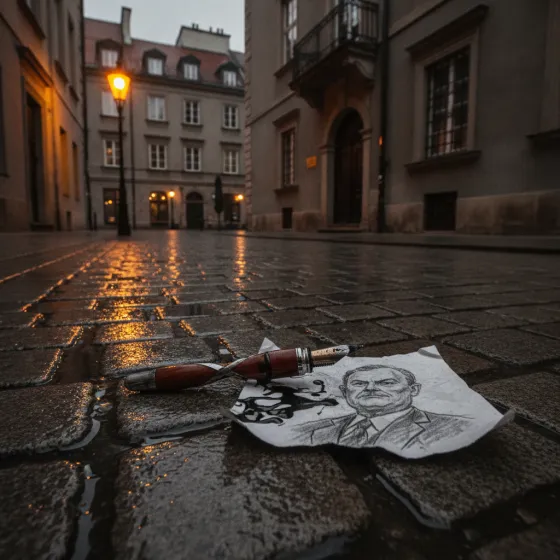
In the world of political satire, the pen is often described as mightier than the sword. But for Robert Kuzovkov, a Russian artist better known by his pseudonym Semyon Skrepetsky, that metaphorical power unfortunately met a very literal and lethal end. Kuzovkov, a man whose illustrations were as sharp as his wit, was recently found shot dead in Poland. It is a chilling reminder that for those who dare to poke fun at the Kremlin, the distance between Moscow and the rest of Europe offers no guarantee of safety.
Who Was Semyon Skrepetsky?
If you haven't seen his work, you have certainly missed a visceral commentary on modern Russian life. Kuzovkov made a name for himself by crafting grotesque, biting caricatures of Vladimir Putin and the wider Russian political elite. His art did not just mock; it exposed the absurdity and the underlying rot of a regime that prides itself on projecting strength while operating behind a curtain of fear.
His drawings were popular on social media, acting as a visual language for those who felt disenfranchised by the current leadership. In a country where dissent is often met with prison sentences or worse, Skrepetsky chose to be a loud, visual voice. Naturally, such visibility comes at a cost.
The Shadow of the Kremlin
While the investigation into his death in Poland is ongoing, the circumstances carry the heavy, familiar scent of state sanctioned intimidation. We have seen this script played out before. From the poisoning of Sergei Skripal in Salisbury to the death of various critics who simply fell out of windows or vanished into the bureaucracy, the message is clear: if you are a vocal critic of the Russian state, there is nowhere to hide.
Poland, which has become a sanctuary for many Russians fleeing the tightening grip of the Kremlin, is now grappling with the reality that their borders are not as secure as they might hope. When a critic is killed on foreign soil, it is an act of geopolitical theatre. It is designed to intimidate, to silence, and to remind the diaspora that the reach of the security services is long and unforgiving.
Why This Matters
You might wonder why this matters to the average person in the UK. Beyond the obvious tragedy of a man losing his life for the sake of free expression, this event highlights the increasing fragility of safety for political refugees across Europe. When authoritarian regimes feel emboldened to conduct operations on European territory, it is not just the victims who are under threat; it is the fundamental principle of free speech.
We like to think that living in a democracy means we are shielded from the consequences of our opinions. But the murder of artists like Kuzovkov serves as a grim reality check. It is a reminder that the battle for democracy is not just fought in parliaments or on battlefields; it is fought in the sketchbooks of artists who refuse to be silenced by threats.
What Happens Next?
The Polish authorities are now tasked with the unenviable job of untangling this web. Will they find the perpetrators? Perhaps. But the damage is already done. The goal of such an act is to foster a climate of self censorship. The hope is that the next artist will put down their pen rather than risk the same fate. Let us hope that the artistic community, both in Russia and abroad, proves them wrong.
Read the original article at source.