
Britain's Iran Balancing Act: Not Quite At War, Not Quite At Peace
Keir Starmer refuses to join US-Israeli strikes on Iran but cannot escape the fallout. How Britain is navigating Trump's pressure and a widening Middle East conflict.










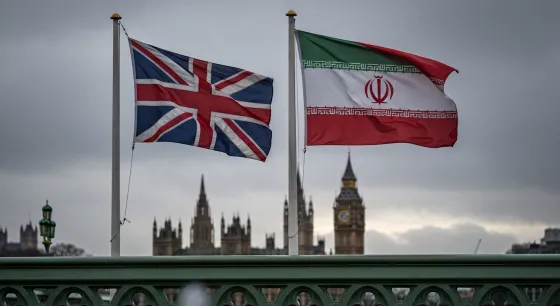
Starmer walks the thinnest of tightropes as Trump ramps up pressure
If you have ever tried to stay neutral at a dinner party where two guests are openly feuding, you will have some idea of Keir Starmer's current predicament. The UK Prime Minister has declared, in no uncertain terms, that Britain will not be joining the US-Israeli offensive against Iran. What he has not quite managed is staying entirely out of the kitchen.

How we got here
The conflict kicked off on 28 February 2026 with joint US-Israeli airstrikes on Iran, an operation that included the assassination of Supreme Leader Ali Khamenei. Since then, the situation has escalated at a pace that makes your head spin. Donald Trump has issued a string of increasingly hostile warnings to allies, telling nations to 'go to the Strait, and just take' oil from the contested Hormuz chokepoint, whilst also cautioning that 'the USA won't be there to help you anymore.'

Cheerful stuff.
The UK's 'it's complicated' status
Starmer told Parliament plainly: 'We are not joining the US and Israeli offensive strikes. This is not our war.' And polling suggests the British public broadly agrees. According to Chatham House analysis from March 2026, 59% of UK voters oppose the Iran conflict, while a Survation poll of 1,045 British adults found 43% considered the war 'not justifiable.'

But the reality is messier than the soundbite. Here is where things get interesting:
Base access: Starmer initially refused the US access to British military bases on 28 February, a decision 56% of the public approved of. By 1 March, however, the UK Defence Ministry confirmed that RAF Fairford and Diego Garcia would be available for 'limited defensive purposes.'
Drone interceptions: UK jets operating from RAF Akrotiri and Al Udeid have intercepted Iranian drones over allied countries including Qatar, Iraq, and Jordan.
Diplomatic initiative: Starmer is currently hosting 35-nation talks on reopening the Strait of Hormuz, pointedly without US participation.
So Britain is not at war, technically. It is just lending its airbases, shooting down drones, and running its own parallel diplomacy. A masterclass in creative ambiguity, or a position that cannot hold forever. Take your pick.
Trump is not impressed
The former and current US President has made his feelings about Starmer's fence-sitting abundantly clear. Trump declared that 'this is not Winston Churchill that we're dealing with,' which is the kind of insult that lands differently depending on which side of the Atlantic you are standing on. He went further, reposting a Saturday Night Live sketch mocking the PM and reportedly impersonating him at a private Easter lunch at the White House.
Secretary of State Marco Rubio piled on, calling the broader allied response 'very disappointing.' The transatlantic relationship, it is fair to say, has seen warmer days.
What happens next?
As of today, 6 April 2026, Tehran has rejected Trump's ceasefire deadline regarding the Strait of Hormuz, meaning the economic and military stakes continue to rise. Starmer's 35-nation summit represents a genuine attempt to find a diplomatic route that does not involve Washington calling the shots.
Whether that approach holds up against the pressure of an escalating conflict and a US President who appears to view allied caution as personal betrayal remains the billion-dollar question. For now, Britain occupies an awkward middle ground: too involved to claim neutrality, too cautious to call it participation.
It is, in the most British way possible, a compromise that satisfies absolutely nobody.
Read the original article at source.