
Britain's Army Can Barely Seize a Market Town, and the Plan to Fix It Just Got Delayed
The UK's smallest army since Napoleon can barely seize a market town. Now the Defence Readiness Bill meant to fix it has been pushed back to 2027.












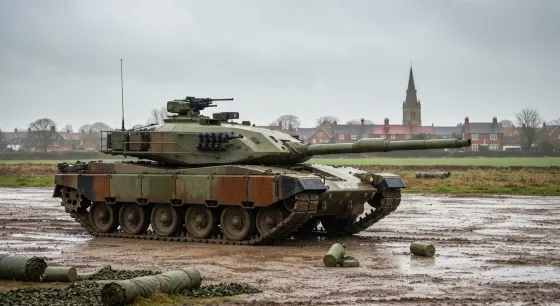
The Defence Readiness Bill Was Supposed to Change Everything. Now It Won't Even Make the King's Speech.
There is something uniquely British about identifying a crisis, drawing up a plan to address it, and then quietly shelving that plan because the timing is not quite right. Welcome to the state of UK defence in 2026, where the army is at its smallest since Napoleon was causing trouble across the Channel and the legislation designed to prepare the country for modern conflict has been pushed back to 2027.
The Defence Readiness Bill, which would grant the government powers to put British industries on a war footing, was supposed to be introduced at the beginning of this year. Defence Minister Lord Coaker said as much. Yet here we are in April, and the bill will not feature in the May 2026 King's Speech. It has been bumped, delayed, and generally treated with the urgency of a dentist appointment you keep meaning to rebook.
How Small Is Too Small?
Let us talk numbers, because they are quite something. The British Army currently has around 72,000 full-time troops. That is down from roughly 100,000 at the turn of the millennium. For context, the fully trained regular strength was reported at just 66,250 as of October 2025. This makes it the smallest British fighting force since the Napoleonic Wars, which, for anyone keeping score, ended in 1815.
General Sir Richard Barrons, a man not known for sugarcoating things, has offered what might be the most brutally honest military assessment in recent memory. The British Army, he said, could "seize a small market town on a good day." Not a city. Not a strategic position. A market town. On a good day. One imagines the bad days involve struggling with a particularly stubborn village fete.
Barrons went further, rating the UK's overall war preparedness as "about a quarter of the way there." He scored Protected Command and Control at a flat zero out of ten. Medical readiness and National Resilience each scraped a two out of ten. And the planning figure for casualties in a major conflict? Six hundred per day. Let that settle for a moment.
What the Bill Was Actually Supposed to Do
It is worth being clear about what is being delayed here. The Defence Readiness Bill is not a routine bit of parliamentary housekeeping. It is specifically designed to give the government the legal tools to mobilise British industry in the event of a serious conflict. Think supply chains, manufacturing capacity, and the kind of national coordination that does not happen by politely asking companies to pitch in.
This is separate from the Armed Forces Bill 2026, which was introduced in January and is making its way through Parliament as expected. That bill deals with renewing existing military law and Armed Forces Covenant duties. Important, certainly, but not the transformative mobilisation legislation that defence experts have been calling for.
The Defence Investment Plan, which outlines equipment procurement priorities, has also been repeatedly delayed. So we have a pattern emerging: identify what needs doing, announce it will be done, then find reasons to do it later.
The Geopolitical Backdrop Makes This Worse
If the world were a calm and predictable place, perhaps kicking the can down the road would be forgivable. The world is not a calm and predictable place.
Regional instability linked to Iran continues to create uncertainty, though the precise trajectory of that situation remains fluid. Meanwhile, across the Atlantic, Donald Trump has been making noises about NATO that should concern anyone who assumed American military support was a permanent fixture. Trump reportedly told UK leadership quite bluntly: "The US won't be there to help you any more."
Whether that is bluster, negotiating tactic, or genuine policy direction, it does rather concentrate the mind. If the transatlantic security blanket is being pulled away, the argument for getting your own house in order becomes significantly more urgent.
Money Is Coming, But Is It Enough?
The government has committed to raising defence spending to 2.5% of GDP by 2027, with a further pledge to reach 3% in the next Parliament. On paper, that sounds like serious money moving in the right direction. The Strategic Defence Review laid out the roadmap, and multiple government departments have confirmed the targets.
But money without the legal framework to deploy it effectively is like buying a fire engine and forgetting to build the fire station. The Defence Readiness Bill is the mechanism that turns increased spending into actual industrial preparedness. Without it, you have a bigger budget but the same peacetime procurement processes, the same sluggish supply chains, and the same inability to scale up quickly when it matters.
Labour Criticising Labour
Perhaps the most telling sign of how badly this delay has landed is that the criticism is coming from within the government's own ranks. Tan Dhesi, Labour's chair of the Defence Select Committee, has publicly questioned the pace of progress. When your own side's defence committee chair is openly frustrated, it is difficult to dismiss concerns as opposition point-scoring.
The accusation of dithering stings particularly because Labour came into government promising to take defence seriously. The Strategic Defence Review was meant to signal a new era of preparedness. Delaying the centrepiece legislation rather undermines that narrative.
What Happens Next
The bill is now expected sometime in 2027, though given the track record, one might be forgiven for pencilling that in lightly. In the meantime, the UK sits in an uncomfortable position: aware of its vulnerabilities, committed in principle to addressing them, but lacking the legislative tools to make it happen at pace.
General Barrons' assessment remains the uncomfortable truth at the heart of all this. A quarter of the way to being ready. Zero out of ten for command and control. Six hundred casualties a day as a planning assumption. These are not abstract figures dreamed up by think tanks. They are the assessments of senior military leaders who have spent careers understanding what modern warfare demands.
The gap between acknowledging a problem and actually solving it is where governments are judged. Britain knows its army is too small, its industries are not on a war footing, and its allies may not always ride to the rescue. The plan to address all of this exists. It just keeps getting postponed.
At some point, the calendar runs out of next years to push things into. Whether that realisation arrives before a crisis forces the issue remains the question nobody in Whitehall seems keen to answer.
Read the original article at source.