
From Apollo to Artemis: Charlie Duke's Intergenerational Message and the Return of Crewed Lunar Exploration
Apollo 16 moonwalker Charlie Duke, 90, addressed the Artemis II crew during humanity's first crewed lunar flyby in over 50 years. Here is why it matters.












A Historic Bridge Between Two Eras of Space Exploration
On the morning of 6 April 2026, as the Artemis II spacecraft approached the Moon for humanity's first crewed lunar flyby in over half a century, NASA played a recorded audio message from one of the few living individuals who has walked on its surface. Charlie Duke, now 90 years old, addressed the four-person crew with words that underscored both the continuity and evolution of human spaceflight.
Duke, who at 36 years and 201 days old became the youngest person to walk on the Moon during the Apollo 16 mission in April 1972, holds a singular perspective on what the Artemis II crew was about to experience. His message, broadcast on Easter Sunday, carried an emotional resonance that extended well beyond its immediate audience.

The Orion Connection
One of the more striking details of Duke's address was his reference to the Apollo 16 Lunar Module, which bore the name Orion, the same name now carried by the Artemis II spacecraft. This nomenclatural coincidence serves as a poignant link between the two programmes, separated by more than five decades yet united in their ambition to extend human presence beyond low Earth orbit.
Duke also referenced the family photograph he left on the lunar surface during his 1972 moonwalk, a personal artefact that remains one of the more evocative symbols of human connection to the celestial body. That such an intimate gesture could echo across generations of explorers speaks to the deeply human dimension of space travel that purely technical accounts often overlook.
Artemis II: A Mission of Firsts
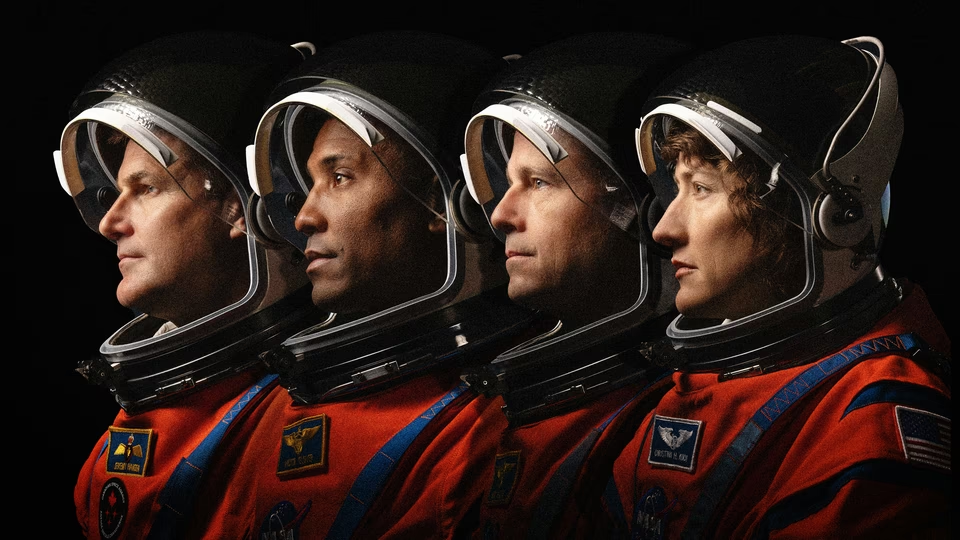
The significance of Artemis II extends considerably beyond its status as the first crewed mission beyond low Earth orbit since Apollo 17 in December 1972. The crew, comprising NASA astronauts Reid Wiseman, Victor Glover, and Christina Koch alongside Canadian Space Agency astronaut Jeremy Hansen, collectively represent several historic milestones:
Victor Glover became the first person of colour to travel around the Moon
Christina Koch became the first woman to undertake a lunar voyage
Jeremy Hansen became the first non-American astronaut to participate in a crewed lunar mission
These milestones reflect a deliberate broadening of who participates in deep space exploration, a shift that carries both symbolic and practical implications for the future of the programme.
The Flyby in Detail
Artemis II launched on 1 April 2026 from Kennedy Space Center, and the lunar flyby itself took place over an approximately seven-hour window between 2:45 PM and 9:40 PM EDT on 6 April. At its closest approach, the Orion spacecraft passed within 4,070 miles of the lunar surface, affording the crew views of approximately 35 geological features, including the Apollo 12 and Apollo 14 landing sites.
The mission also set a new record for the greatest distance from Earth achieved by a crewed spacecraft, reaching 252,760 miles and surpassing Apollo 13's long-standing record of 248,655 miles. The flyby was broadcast live across multiple platforms, including NASA+, YouTube, Netflix, and several other streaming services, reflecting a contemporary approach to public engagement that would have been unimaginable during the Apollo era.

Contextualising the Achievement
Duke's message to the Artemis II crew functions as more than a sentimental gesture between generations of astronauts. It represents an acknowledgement that Artemis builds upon foundations laid during Apollo while charting a distinctly different course. Where Apollo was driven primarily by geopolitical competition, Artemis operates within a framework of international cooperation and inclusivity.
The fact that a 90-year-old moonwalker can speak directly to a crew that includes the first woman, first person of colour, and first non-American to orbit the Moon illustrates how profoundly the character of space exploration has changed, even as its fundamental aspirations remain remarkably consistent.
Read the original article at source.