
After 50 Years of Loyal Service, the Humble Barcode Is Getting a Square Makeover
Tesco is trialling 2D QR-style barcodes across southern England. Here's why the humble barcode is finally getting an upgrade after 50 years of loyal service.












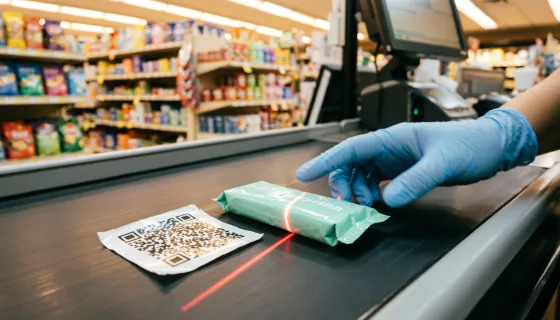
Cast your mind back to 1974. Richard Nixon was sweating through his final days in the White House, ABBA won Eurovision, and a pack of Wrigley's Juicy Fruit chewing gum in Ohio became the first product ever to have its barcode scanned at a supermarket checkout. That modest little beep changed retail forever.
Now, roughly 52 years and billions of beeps later, the trusty striped barcode is facing its most serious challenge yet. Tesco is actively trialling a new generation of QR-style codes on products in stores across southern England, and if all goes to plan, those familiar black-and-white lines could eventually make way for something altogether smarter.
What Is Actually Happening?
Before we get carried away (some headlines have been rather dramatic about barcodes being "axed"), let's establish the facts. Tesco has partnered with GS1 UK and 10 supplier partners to trial what are known as "2D barcodes" on 12 own-brand meat and produce lines. We're talking lemons, limes, steaks, and sausages. Not exactly the full weekly shop, but it's a meaningful start.
The trial covers roughly 20% of Tesco's store estate in southern England. So if you're doing your big shop in Newcastle, you won't be encountering these square codes just yet. But for shoppers in the south, the quiet revolution has already begun.
So What's Wrong With Regular Barcodes?
Nothing, really. Traditional barcodes have been extraordinary workhorses. An estimated 10 billion of them are scanned every single day worldwide. They're cheap, reliable, and universally understood. The problem is that they're also rather limited in what they can actually tell a checkout system.
A standard barcode essentially says: "I am a 500g pack of beef mince." That's it. It doesn't know when it was packed, when it expires, or which batch it came from. It's the retail equivalent of a name badge with no job title.
The new 2D barcodes, by contrast, are packed with data. They can encode use-by dates, batch numbers, and supply chain information directly into that little square. Think of them as barcodes that went to university and came back considerably more useful.
How This Stops You Buying Gone-Off Sausages
Here's where things get genuinely interesting for shoppers. Because these new codes contain expiry date information that the point-of-sale system can actually read, it becomes possible for checkouts to flag or even block the sale of out-of-date products.
We've all been there. You grab a pack of chicken from the reduced section, get home, and discover it expired yesterday. With 2D barcodes, the till itself could catch that before you tap your card. No more playing expiry date roulette at the self-checkout.
The implications for food waste are significant too. A Brazilian deli shop that adopted GS1 QR codes reportedly reduced its waste by 50% in just two months. Now, one small deli in Brazil doesn't exactly constitute rock-solid industry-wide evidence, but the principle is sound. If shops can track expiry dates more precisely, they can manage stock more intelligently, discount items at the right time, and pull products before they become a sad offering in the reduced bin.
The Bigger Picture: GS1 Sunrise 2027
This isn't just a Tesco pet project. There's a global initiative called GS1 Sunrise 2027, which has set a target for all point-of-sale systems worldwide to be capable of scanning QR-style codes by the end of 2027. The technology is already being tested in 48 countries representing 88% of global GDP. Major brands including PepsiCo, Nestle, L'Oreal, and Procter & Gamble have all signed a joint statement backing the migration.
Globally, retailers like Walmart, Kroger, and Carrefour are participating in the initiative, though it's worth noting that in the UK specifically, Tesco appears to be leading the charge. Claims about "other major retailers" rolling out the technology on British soil are, at the time of writing, not well evidenced. This is primarily a Tesco story for now.
GS1 UK, which has around 60,000 members, is coordinating the UK side of things. According to a YouGov survey conducted between February and March 2025, only about 25% of UK businesses are even aware that this transition is coming. However, nearly 50% of GS1 UK members indicated they could adopt QR codes by 2026, which suggests the supply side is moving faster than many retailers might expect.
Don't Panic: Your Barcodes Aren't Disappearing Tomorrow
Despite some breathless headlines, the humble barcode isn't about to vanish overnight. GS1 officially recommends a dual-barcode coexistence approach until at least 2027, meaning products will carry both the old-style barcode and the new 2D version simultaneously. The full transition could realistically take years, possibly even decades, beyond that.
Isabela De Pedro, Tesco's Supply Chain Development and Change Director, is the executive behind the trial, and the approach is clearly cautious and phased. This is actually Tesco's second crack at QR codes. The first trial ran back in June 2024 but focused on consumer-facing features like detailed product information. The current trial is more operationally focused, dealing with the nuts and bolts of use-by dates and batch tracking. Consumer-friendly features like recipe suggestions and allergen information are planned for future phases.
What This Means for Your Weekly Shop
In the short term, honestly, not much. You'll still scan your shopping the same way you always have. The checkout experience won't dramatically change, and you certainly won't need to download any apps or learn any new skills.
In the medium term, though, the benefits could be quite tangible:
- Fewer expired products slipping through: The system can catch what tired human eyes sometimes miss.
- Better food safety: If there's a product recall, batch-level tracking means shops can identify and remove affected items with surgical precision rather than pulling entire product lines.
- Smarter reductions: Stores could automatically discount items as they approach their use-by date, which is good for bargain hunters and the planet alike.
- Richer product information: Future phases could see you scanning a code with your phone to access recipes, sourcing details, and allergen information.
The Verdict
The barcode has had an extraordinary run. From that first packet of chewing gum in Ohio to 10 billion daily scans worldwide, it's one of the most successful and underappreciated inventions in modern commerce. But technology moves on, and the 2D barcode offers genuinely useful improvements that go well beyond a cosmetic upgrade.
Is this the end of the barcode as we know it? Eventually, probably yes. But "eventually" in retail terms means a long, gradual transition with plenty of overlap. For now, Tesco's trial in southern England is a promising first step on what will be a very long road.
The striped barcode served us well. Its square successor looks like it might serve us even better.
Read the original article at source.