
Trump Insists US-Iran Ceasefire Holds After Hormuz Fireworks (Yes, Really)
US destroyers and Iran trade fire in the Strait of Hormuz on 7 May 2026, yet Trump insists the ceasefire is intact. Here's what actually happened.










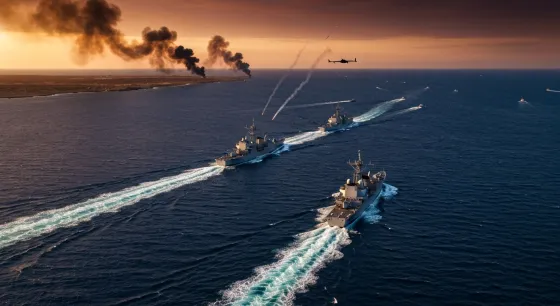
Well, that escalated quickly. Or did it? Depending on whom you ask, the US and Iran either had a brief, very loud disagreement in the Strait of Hormuz on 7 May 2026, or the ceasefire is absolutely fine, thanks for asking. Donald Trump is firmly in the latter camp, even after three US Navy destroyers found themselves dodging Iranian missiles, drones and small boats while transiting one of the world's busiest oil corridors.
If your definition of 'ceasefire' includes an exchange of fire, congratulations, you might have a future in international diplomacy.
What actually happened
According to US Central Command, the USS Truxtun, USS Rafael Peralta and USS Mason came under what CENTCOM described as an 'unprovoked' attack while passing through the Strait of Hormuz. The US response was swift, targeting Iranian missile and drone launch sites along with command nodes. CENTCOM says no American assets were hit, despite Iranian claims of significant damage.
Iran, predictably, tells a different story. Tehran accuses Washington of breaching the truce, alleging the US struck an Iranian oil tanker and carried out aerial attacks on coastal areas including Bandar Khamir, Sirik and Qeshm Island. The UAE also got dragged into the chaos, with its Ministry of Defence saying its air defences engaged a missile and drone attack originating from Iran.
This was reportedly the second exchange involving the same three destroyers within days, and described as fiercer and more sustained than the earlier round. Charming.
'Love tap', apparently
Trump, speaking to ABC News in remarks not included in the BBC's coverage, referred to the US strikes as a 'love tap'. Which is certainly a phrase. He insists the ceasefire that began on 8 April 2026, originally a two-week temporary truce later extended, remains intact.
His position is essentially this: a bit of mutual missile-flinging is just the relationship having a moment. The ceasefire endures because, well, he says it does. Diplomacy through sheer force of assertion.
A quick recap for the non-obsessed
For anyone who has tuned out since February, here is the short version. Operation Epic Fury (or Operation Roaring Lion, if you prefer the Israeli branding) kicked off on 28 February 2026. As of 7 May, we are on day 69 of the broader Middle East conflict. Iran's Supreme Leader Ayatollah Khamenei was reportedly killed in the opening hours of the operation, a detail that rather changes the political furniture in Tehran.
US Secretary of State Marco Rubio has already declared Operation Epic Fury over, claiming it achieved its objectives. The current phase is meant to be about cementing a longer term arrangement, not lobbing things at warships.
The 14-point plan nobody can agree on
Behind the smoke, there is paperwork. The White House believes it could be closing in on a 14-point memorandum of understanding with Iran, according to Axios reporting. Pakistan is acting as mediator, and Iran's foreign minister has confirmed the proposal is under consideration.
Enthusiasm in Tehran is, shall we say, mixed. Ebrahim Rezaei, spokesperson for Iran's parliamentary national security commission, publicly dismissed the 14-point document as a 'wish list'. That is not the language of a man about to sign on the dotted line.
Trump claims Iran has agreed never to pursue a nuclear weapon as part of the framework. Tehran has not confirmed that, and the BBC and other outlets have flagged this point as disputed. Treat with appropriate scepticism.
Trump's Truth Social ultimatum
On 6 May, the day before the latest exchange, Trump posted on Truth Social warning of higher intensity bombing if a deal is not reached. Whether the 7 May fireworks were a response to that post, a coincidence, or someone's idea of negotiating leverage is anyone's guess.
What is clear is that the rhetoric is not exactly cooling. The pattern of public threat followed by kinetic exchange followed by 'the ceasefire is fine, actually' is becoming familiar.
Why this matters to your wallet
This is the bit that affects you, the British reader staring at a petrol pump and wondering why filling up costs the same as a small holiday. The Strait of Hormuz carries roughly a fifth of global oil shipments. Any sustained disruption sends energy markets into a spin, and that ripples through to fuel prices, household bills and the cost of more or less everything that arrives by lorry.
So far, the exchanges have been short and contained, but the risk premium is already baked into oil prices. A more serious incident, particularly one involving a sunk vessel or extended closure of the strait, would be a headache for chancellors everywhere, including ours.
UK households are still feeling the lingering effects of the last energy shock. Another one, courtesy of the Persian Gulf, is not on anyone's wish list except possibly oil traders with a strong stomach.
Was Israel involved?
According to an unnamed Israeli source quoted by the BBC, no. That claim has not been independently corroborated, so file it under 'plausible but unverified'. Given that the broader operation has had Israeli branding from day one, the question of who fires what and when is unlikely to disappear quietly.
The big picture
What we have is a ceasefire that exists in theory, gunfire that exists in practice, and a peace framework that one side calls progress and the other calls a wish list. Throw in a US president who can casually describe airstrikes as a 'love tap', a mediating role for Pakistan, and an oil chokepoint that the global economy genuinely cannot afford to lose, and you have a situation that is either heading for a deal or heading for something considerably worse.
The optimistic read is that both sides are letting off steam while the real negotiations grind on in the background. The pessimistic read is that a single misjudged shot in a crowded shipping lane could turn day 69 into something far longer.
Either way, if you are planning a long drive this summer, perhaps top up the tank now.
The verdict
The ceasefire is technically alive, practically wobbling, and politically essential to everyone involved. Trump's insistence that everything is fine has a touch of the 'this is fine' meme about it, but the alternative, admitting the truce has cracked, would be far worse for markets, allies and any chance of that 14-point deal landing. Watch the strait, watch oil prices, and watch what Tehran says next. The rhetoric will tell you more than the rockets.
Read the original article at source.