
Six Seconds, No Transponder, Two Controllers: The Deadly Chain of Failures at LaGuardia
How conflicting ATC instructions, minimal staffing, and a six-second window led to the fatal LaGuardia runway collision involving Air Canada Express AC8646.












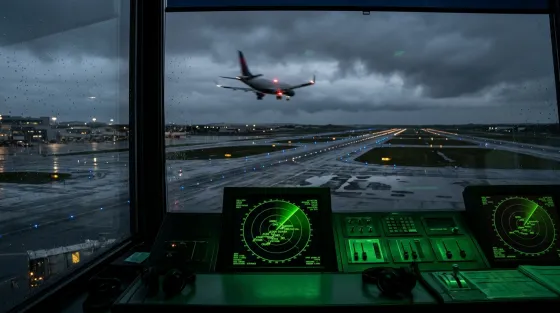
It takes roughly six seconds to tie a shoelace. On the night of 23 March 2026, six seconds was all that separated Air Canada Express Flight AC8646 from a safe landing and a catastrophe. That vanishingly small window tells you everything about how thin the margins are in aviation, and how spectacularly the safety net failed at LaGuardia Airport.
What We Know
Flight AC8646, a CRJ-900 operated by Jazz Aviation, was on a routine hop from Montreal carrying 72 passengers and 4 crew. At approximately 11:40 PM ET, the aircraft touched down on Runway 4 in foggy, misty conditions. Two seconds after touchdown, Captain Antoine Forest took positive control from First Officer MacKenzie Gunther, who had been flying the approach.
Six seconds later, the plane slammed into a Port Authority fire truck at an estimated 93 to 105 mph.
Both pilots were killed. Forty-one passengers and two firefighters were hospitalised, though 32 were later released. It was LaGuardia's first fatal crash in roughly three decades.
Why Was a Fire Truck on an Active Runway?
Here is where the story shifts from tragic to genuinely baffling. The fire truck had been dispatched to attend a United Airlines flight that reported an unusual odour on board. It was cleared to cross the runway while Flight AC8646 was simultaneously cleared to land.
Read that again. Two contradictory instructions, issued from the same control tower, at the same time.
Only two air traffic controllers were working the overnight shift. The NTSB has noted this was considered standard for the midnight roster, though it has also flagged "conflicting information" in the tower's staffing logs that investigators are still untangling.
To compound matters, a critical radio transmission was "stepped on" (partially blocked by another signal) roughly one minute before impact. When a controller finally spotted the danger, they shouted: "Truck One, stop, stop, stop!"
It was too late. After the collision, the same controller was heard saying, in a shaken voice: "I messed up."
The Transponder Problem
Modern airports have surface detection systems designed to prevent exactly this kind of scenario. LaGuardia has one. It did not issue a collision warning.
Why? The NTSB found that multiple vehicles clustered near the runway confused the system. And the fire truck itself had no transponder, meaning the tower had limited ability to track its position electronically. The NTSB chair noted the truck "should have been equipped" with one, even though no formal recommendation to that effect existed.
So to recap: no transponder on the truck, a detection system that choked when it mattered most, and two controllers juggling an active runway in fog. The holes in the Swiss cheese lined up perfectly.
Inside the Cockpit
Data from both recovered black boxes paints a grim picture of just how little time the crew had. Passenger Rebecca Liquori later reported feeling the pilots brake hard before impact, and credited their actions with saving lives. Given that Captain Forest had only six seconds between taking control and the collision, that speaks to extraordinary reflexes under impossible circumstances.
In a detail that investigators have called a "total miracle," a flight attendant was found alive outside the aircraft, still strapped into a seat that had fallen through the ruptured fuselage.
What Happens Next
The NTSB investigation is zeroing in on three key areas: ATC staffing levels during overnight shifts, the absence of transponders on ground vehicles, and the failure of LaGuardia's surface detection system. These are systemic questions, not individual ones, and the answers will likely reshape ground operations at airports across North America.
Six seconds. That is all the margin that existed between a routine landing and a disaster. The question now is whether the industry will use this tragedy to buy back a few more.
Read the original article at source.