
The Rulebook Is Burning: How the Iran War Tore Up Every Norm of International Conflict
The US-Israel strikes on Iran broke diplomatic norms, targeted a head of state, and caused mass civilian casualties. Here is what it means for international law.










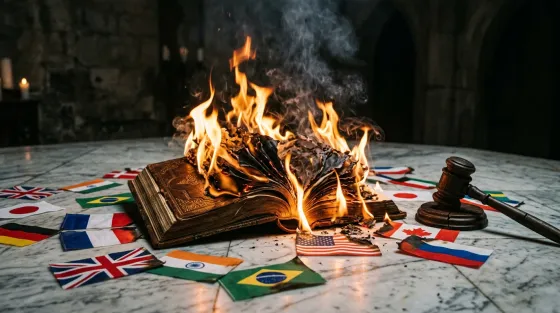
If international law were a physical book, the events of February 2026 would be the equivalent of tossing it into a bonfire and toasting marshmallows over the flames.
When the US and Israel launched surprise airstrikes on Iran on 28 February 2026, they did not just hit military targets. They hit the foundations of the rules-based international order that has, however imperfectly, governed conflicts since 1945. And the aftershocks are still reverberating.
Diplomacy? What Diplomacy?
Here is the part that should make your jaw drop. The most intense round of US-Iran diplomatic talks had concluded in Geneva on 26 February, just two days before the bombs started falling. Both sides had agreed to continue discussions. The ink on the negotiating notes was barely dry.
Nearly 900 strikes were launched in the first 12 hours. By week four, US CENTCOM had struck over 8,000 Iranian targets. This was not a proportional response to an imminent threat. US intelligence had assessed that Iran was not even pursuing nuclear weapons at the time.
Targeting a Head of State
Supreme Leader Ali Khamenei was killed in the initial strikes, with Iranian state media confirming his death on 1 March. Whatever one thinks of Khamenei's regime, the deliberate assassination of a sitting head of state violates the New York Convention on the protection of diplomatic and state figures. Even Russia's Vladimir Putin, hardly a poster child for international law, called it a "cynical violation of all norms of human morality and international law."
When Putin is lecturing you on morality, it might be time for some quiet reflection.
The Human Cost
The civilian toll has been staggering. By 3 March, the Iranian Red Crescent reported over 600 civilian deaths, with Human Rights Activists in Iran estimating 742. By 7 March, some 6,668 civilian sites had been targeted, including:
- 5,535 residential units
- 65 schools
- 14 medical centres
Reports from Minab suggest at least 100 girls aged 7 to 12 were killed when an elementary school was struck, though casualty figures in active conflicts remain subject to dispute. UNESCO condemned the damage to the Golestan Palace, a World Heritage Site in Tehran. Because apparently nothing is off limits.
Ripple Effects Across the Globe
Iran retaliated against Gulf neighbours, firing over 500 ballistic and naval missiles alongside nearly 2,000 drones since 28 February. Oil prices surged roughly 45%, with crude topping $110 per barrel. Over 3,000 vessels were left stranded as Strait of Hormuz traffic ground to a near-total halt. Given that approximately 20% of global oil and LNG passes through those waters, the economic fallout has been swift and brutal. The IMF warned that every 10% rise in energy prices could push global inflation up by almost 0.5%.
Meanwhile, the sinking of the Iranian Navy frigate IRIS Dena on 4 March by USS Charlotte near Sri Lanka killed 87 of the roughly 180 crew aboard. The vessel was returning from an international fleet review in India and was effectively disarmed. It marked the first US submarine torpedo sinking since World War II, and the first nuclear submarine sinking of a surface vessel since the Falklands War in 1982.
Where Does This Leave Us?
The overwhelming majority of international law experts agree the strikes violated Article 2(4) of the UN Charter. The UN Secretary-General said as much. German President Steinmeier called it a "disastrous violation of international law." Spain's Prime Minister Sanchez echoed the sentiment. Yet the US acted without congressional authorisation, citing only Commander in Chief authority.
The rules of international conflict have not just been bent. They have been snapped in half, set on fire, and scattered to the wind. The question now is whether anyone has the will to pick up the pieces.
Read the original article at source.