
Plug-In Solar Panels From Lidl and Heat Pumps in Every New Home: The UK's Green Tech Shake-Up
The UK is bringing plug-in solar panels to supermarkets and mandating heat pumps in new builds. Here's what the green tech changes mean for homeowners.












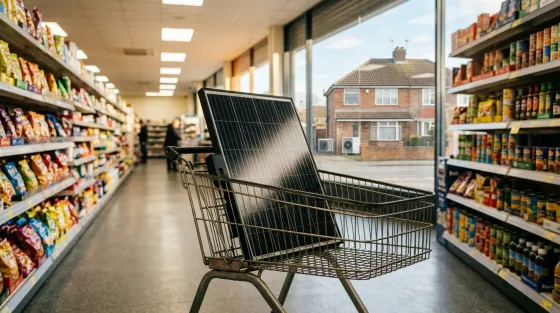
Solar Panels in Your Shopping Trolley? Welcome to 2026
If you thought the most exciting thing you could pick up at Lidl was a middle-aisle pressure washer, think again. The UK government has just announced that plug-in solar panels will be available to buy in supermarkets and online retailers within months. Yes, genuinely. Solar energy, wedged somewhere between the bakery section and the ski gear.
The announcement forms part of a broader green technology push that also mandates heat pumps and solar panels for all new-build homes under the Future Homes Standard. It is, by any measure, the most ambitious shake-up of how Britain builds and powers its homes in a generation.
What Are Plug-In Solar Panels, Exactly?
The concept is disarmingly simple. These are small solar panel systems, capped at under 800W, that connect directly to a standard mains socket. No electrician required. No scaffolding. No three-month wait for an installer who never returns your calls.
Retailers including Amazon, Lidl, and manufacturer EcoFlow are already lined up to bring them to the UK market. Germany has been doing this for a while now, with roughly 426,269 balcony solar system registrations in 2025 alone, running at a pace of around 500,000 devices per year. The UK is essentially borrowing a proven playbook and running with it.
The regulatory changes needed involve updates to the G98 distribution code and BS 7671 wiring regulations, which is about as thrilling as it sounds, but absolutely necessary to make this work safely.
New Homes: Heat Pumps and Solar as Standard
Under the Future Homes Standard, every new home will be built with solar panels and a heat pump fitted as standard. The government says these homes will produce at least 75% fewer carbon emissions than those built to 2013 regulations, and could save homeowners up to £830 annually compared to an EPC rating C property.
Over 25% of new UK homes built in 2025 already had heat pumps installed, so the industry is not starting from scratch. The target is to reach 450,000 heat pump installations per year by 2030, split roughly between 200,000 for new builds and 250,000 for existing homes.
It is worth noting a timing wrinkle here. While some sources reference the standard taking effect from early 2026, the official GOV.UK press release from 24 March 2026 states implementation from 2028. This likely reflects a transitional compliance period, but prospective buyers should keep an eye on the exact timeline.
The Warm Homes Plan: £15 Billion to Fix Britain's Draughty Housing
New builds are only half the story. Britain's existing housing stock is, to put it diplomatically, not brilliant at keeping heat in. Home insulation installations fell a staggering 90% between 2010 and 2024, which is the kind of statistic that makes you want to put another jumper on just reading it.
The government's Warm Homes Plan commits £15 billion in public investment to upgrade up to 5 million homes, with the aim of lifting up to 1 million families out of fuel poverty by 2030. For context, 1.6 million children currently live in cold, damp, or mouldy private rental accommodation. The scale of the problem is not small.
Key measures include a universal £7,500 grant for heat pumps, a separate £2,500 grant for air-to-air systems, and a wind farm discount scheme offering cheaper bills during windy periods, primarily benefiting households in Scotland and Eastern England.
The plan is expected to create 180,000 additional jobs in energy efficiency and clean heating by 2030, with total investment across Parliament projected at £38 billion.
Why Now?
Energy Secretary Ed Miliband framed the urgency partly around energy security, referencing the Iran war as a reminder of why dependence on volatile global energy markets is a liability. Buildings account for 23% of UK total carbon emissions, and the government has set a target to triple homes with rooftop solar from 1.6 million to 4.6 million by 2030.
Housing Secretary Steve Reed, meanwhile, tied it to the government's target of building 1.5 million new homes, arguing that greener homes and more homes are not competing objectives.
The Verdict
The ambition here is genuine and the numbers are substantial. Whether the delivery matches the rhetoric remains the great British question, but plug-in solar panels on supermarket shelves is the kind of quietly radical move that could shift how ordinary people engage with renewable energy. If Germany can do it at scale, there is no good reason Britain cannot.
Read the original article at source.