
ICE Agents Land at US Airports as TSA Crisis Turns Check-In Into a Contact Sport
Hundreds of untrained ICE agents now staff 14 major US airports as TSA resignations spike during the DHS shutdown. Here's what it means for travellers.












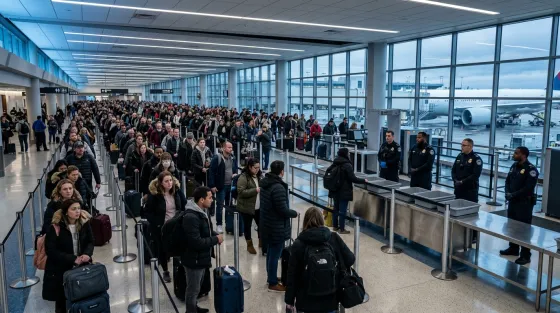
If you thought airport security was already a masterclass in patience, the US government has outdone itself. Hundreds of ICE agents have been deployed to 14 major airports across America, not to catch smugglers or foil elaborate heist plots, but because there simply aren't enough TSA officers to keep the queues moving.
Welcome to week six of the DHS shutdown.
How We Got Here
The Department of Homeland Security has been in partial shutdown since 14 February 2026, after its funding expired amidst a political standoff in Congress. The catalyst? The fatal shootings of two US citizens, Renee Good and Alex Pretti, by federal immigration agents in Minneapolis back in January. Democrats blocked DHS funding, demanding reforms including judicial warrant requirements, body cameras, stricter use-of-force policies, and a ban on ICE agents wearing masks.
The DHS funding bill has now failed to advance five times. Meanwhile, TSA officers have gone unpaid for over a month, and predictably, they have started walking out the door. More than 400 TSA officers have resigned since the shutdown began, and the nationwide callout rate hit 11.76% on Saturday 22 March, the highest since this whole mess kicked off.
Some airports have it far worse. New Orleans recorded a staggering 42.3% callout rate. Atlanta hit 41.5%. JFK managed 37.4%. Houston Hobby briefly reached a jaw-dropping 55% on a single day in mid-March. That is more than half the workforce simply not showing up.
Enter the ICE Agents
Border czar Tom Homan announced on Sunday that ICE agents would deploy to airports the following morning, with a minimum of 50 personnel per shift at each location. The 14 airports include heavyweights like JFK, O'Hare, Atlanta Hartsfield-Jackson, and Houston Hobby, among others.
But here is the thing: ICE agents are not trained in aviation security. TSA certification takes four to six months. These agents lack SIDA badges (the credentials needed to access secure checkpoint areas), so their role is limited to crowd control, ID checks, and guarding exits. They will not be operating the scanners or patting anyone down.
Everett Kelley, president of the AFGE union representing over 50,000 TSA employees, has been vocal about the distinction. Having armed immigration agents milling about in an airport is not the same as having trained security professionals screening passengers. One keeps the queues orderly; the other keeps the skies safe.
Six Hours to Board a Plane
The real-world impact has been brutal. Travellers at Hartsfield-Jackson Atlanta reported wait times of up to six hours over the weekend. Both Atlanta and Houston Bush Intercontinental advised passengers to arrive at least four hours before their flights. For context, you could fly from London to Paris and back in that time.
The ACLU condemned the deployment, stating that never in American history has a president sent armed agents to airports "to inspire fear among families." Even Republican Senator Lisa Murkowski questioned the wisdom of adding "additional tensions on top of what we are already facing."
Atlanta Mayor Andre Dickens offered some reassurance, noting that federal agents indicated the deployment was "not intended to conduct immigration enforcement activities." Whether travellers find that comforting while surrounded by armed officers in six-hour queues is another matter entirely.
What Happens Next?
Until Congress resolves the funding standoff, this is the new normal. TSA officers continue working without pay, resignations will likely climb, and ICE agents will remain the world's most overqualified queue managers. The irony of a government that can fund immigration enforcement but not airport security is not lost on anyone paying attention.
If you are flying through a US airport any time soon, pack your patience. And maybe a book. A very long one.
Read the original article at source.